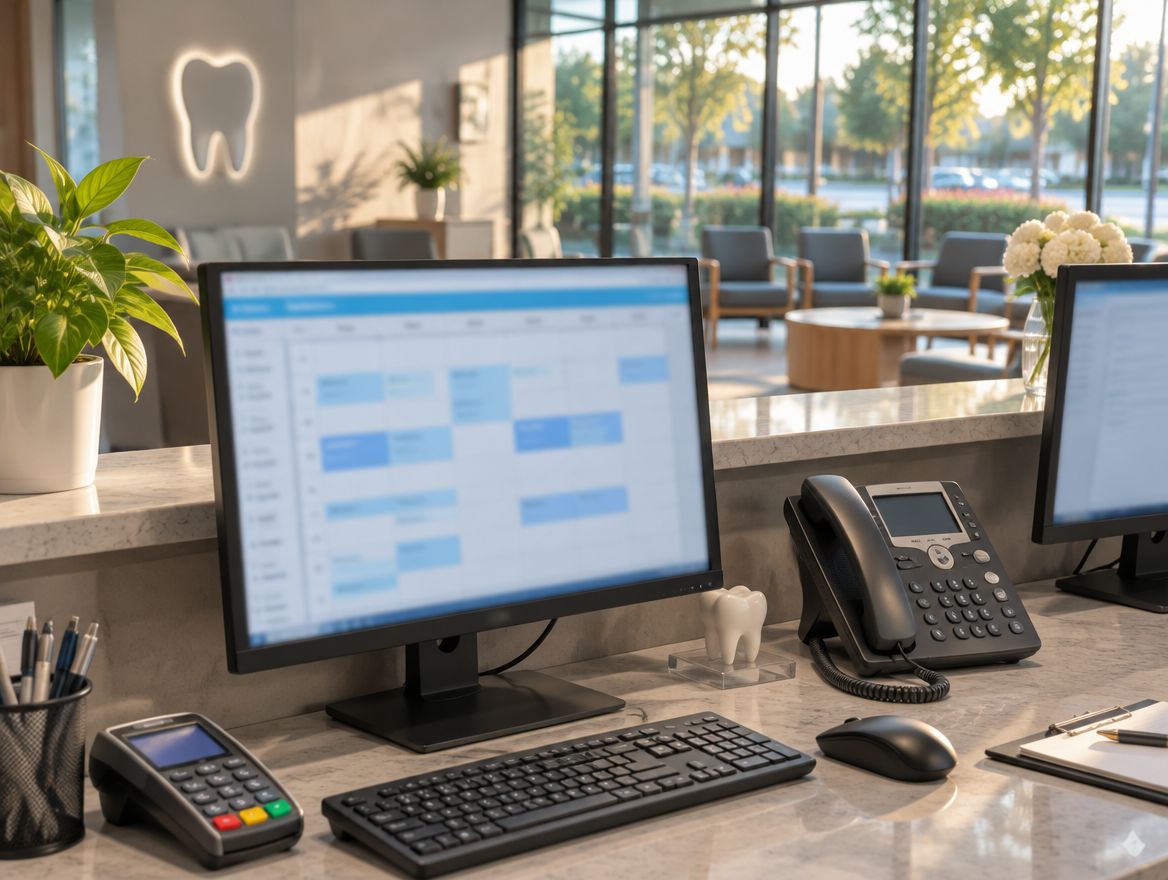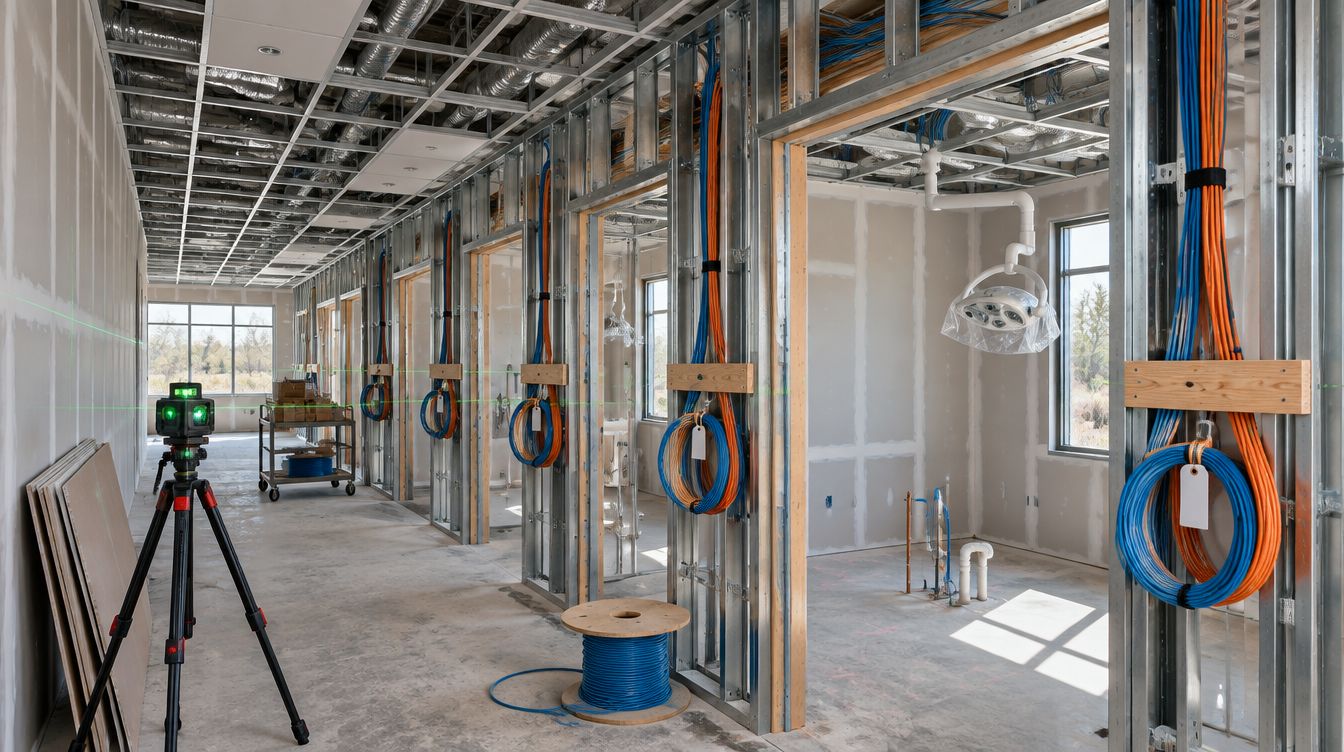
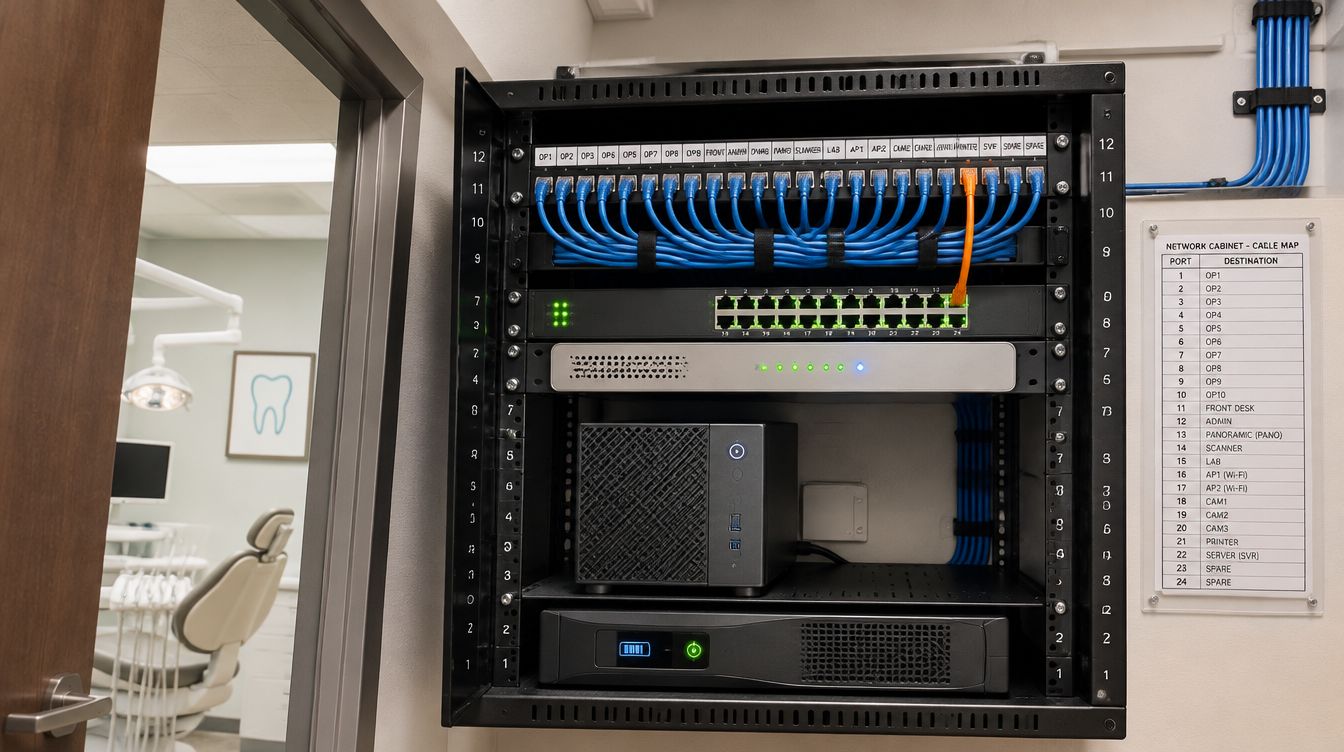
For a Boston dental office buildout, the technology is easiest to get right while the walls are still open: cable to every chair and sensor, WiFi, door access, cameras, displays, the phones, the server and the computers, sequenced against the contractor's dates. ClearMax technicians handle that whole list as a single project, without a monthly agreement.
Last updated: November 2026
Everything the practice plugs in, on one schedule
A Boston fit-out often ends up with five separate vendors touching the network: a cabling shop, a phone company, an alarm installer, an IT firm and the dental dealer. Each assumes another owns the switch, the closet power or the camera recorder. One scope removes that guesswork:
- Network cable installation: numbered runs from chairs, imaging, reception and ceilings to a single panel.
- Commercial WiFi: ceiling units on separate staff and guest networks.
- Phones: handsets wired to the same switch, with a way to call out when the internet is down.
- Door access: fobs or cards on the staff entrance, the closet and any drug or records room, planned around how people leave.
- Cameras: doors, reception from the waiting-room side and hallways, with no sound recorded.
- Displays: planned with the rest of the buildout.
- The server and desk computers: built to the practice software's published server requirements and tested at each station.
Why the phones belong in the IT plan
Massachusetts treats the ability to call for help as part of running a dental practice. Board of Registration in Dentistry rule 234 CMR 5.15 requires a dental practice to have communication equipment that ensures rapid access to emergency responders. Most new offices run their phones over the network, so a dead switch or a cut internet line can silence every handset at once. The plan puts the phone switch on battery, keeps at least one way to dial out that does not depend on the office internet, and tests it at handover.
Old buildings, flood maps and winter storms
Much of Boston's medical space sits in older masonry buildings and converted floors, where thick walls, plaster ceilings and shared basements change how cable runs and where equipment can go.
The basement is the usual trap. A Better City's summary of Boston's Coastal Flood Resilience Overlay District says the ordinance allows side- and rear-yard encroachments for new structures that house mechanical systems, so those systems do not have to sit in basements or below the Sea Level Rise Design Flood Elevation. A server closet follows the same logic: in a building inside the overlay, it goes on an occupied floor above the design flood elevation, not in the free corner of the basement.
Winter weather is the other test. The Department of Energy's report on the March 2, 2018 nor'easter listed a peak of 156,742 customer outages in Massachusetts. A closet battery cannot carry an office through that. It holds the network for a few minutes and shuts the server down cleanly; the copy that restores the practice lives outside the building and is restored once at handover to prove it.
Opening a first office, adding a second, or moving?
A first office starts from an empty floor and a lease date. A second location raises a question the first never did: does it share the original practice's database or keep its own? That one answer decides whether the new office needs a server, what the connection between the two must carry, and how staff who split their week sign in at each. A relocation adds a third clock, the patient schedule. Every device that follows the practice is listed, moved on a planned evening and tested in the new space before the first appointment, and the old server is left untouched until the new one has passed its morning check. Records go with the practice, so the plan also covers where old drives end up and when.
No sound on the cameras, ever
Massachusetts is an all-party state for recording conversations. Chapter 272, section 99 of the General Laws treats secretly recording a conversation with a device, without prior authority from all parties, as an interception. Many cameras ship with microphones switched on, so audio is disabled at every camera and at the recorder, and the setting is confirmed in writing at handover.
The software vendor's part
Carestream Dental's practice software is published under the Sensei name, and its support desk stays the first call for anything inside the program. The plan checks the server and workstations against the vendor's current sheet before anything is ordered; support starts at carestreamdental.com. Practices that want ongoing care after opening can look at managed dental office IT.
Boston practices usually ask
How soon should IT be in the conversation?
When the first floor plan exists. Cable and door wiring go in during rough-in, and older buildings take longer to route through than the drawing suggests.
Can you work beside a phone vendor we already chose?
Yes. The plan lists what the phones need from the network, the switch ports, power and the dial-out line, so the two pieces fit.
Is there a monthly fee?
No. The buildout has a written scope and an end; a plan afterward is optional.
How do you price it?
The quote is built from the details the practice provides. If more work is needed, it is brought to the practice's attention and the bid is updated.